
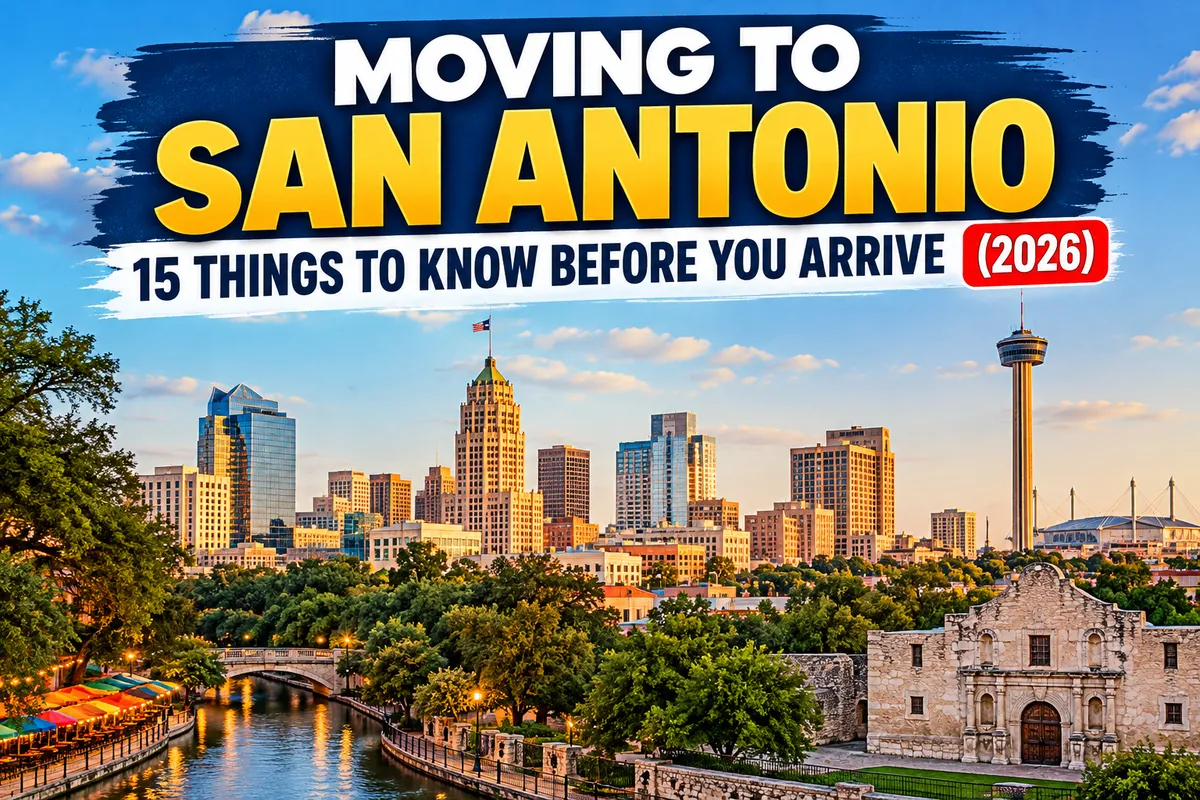
Moving to San Antonio: 15 Things to Know Before You Arrive (2026)
Moving to San Antonio: 15 Things You Need to Know Before You Arrive
San Antonio has a way of surprising people. Newcomers expect the River Walk and Tex-Mex. They don't always expect how big the metro is, how much property taxes vary by address, or how closely locals watch the Edwards Aquifer. If you're thinking about a move to Greater San Antonio or the Texas Hill Country, these 15 things will help you plan with fewer surprises. Each one is based on current local sources.
The Basics: Size, Geography and the Housing Market
1. San Antonio Is a Very Big City
San Antonio is not a small Texas town. TheU.S. Census Bureau's Vintage 2025 estimatesput the city's population at 1,548,422 as of July 1, 2025. That makes it the seventh-largest city in the country. The city added 14,359 residents in one year, the third-largest numeric gain of any U.S. city. In practice, that means new rooftops, new schools and lots of road work on the growing edges of the metro.
2. "San Antonio" Usually Means a Whole Region
Many people who say they're moving to San Antonio end up in a nearby city or an unincorporated part of a county. The metro reaches north into the Hill Country (Boerne, Bulverde, Spring Branch). It runs northeast along I-35 (Schertz, Cibolo, New Braunfels) and east toward Seguin and La Vernia. Locals describe locations by the two highway loops: inside Loop 410, between 410 and Loop 1604, or outside 1604. Each zone comes with different home ages, lot sizes, commutes and tax bills. If you're comparing areas, our guides toBoerne,La VerniaandSan Antonio vs. New Braunfelsare good places to start.
3. Buyers Have More Leverage Than They Did a Few Years Ago
The bidding wars of the early 2020s are over for now. In August 2026, San Antonio-area home sales rose 4% year over year, according toTexas Public Radio's report on San Antonio Board of REALTORS® data. The same report showed just under six months of inventory and an average of about 82 days on market, longer than a year earlier. Four to six months of supply is usually called a balanced market. That gives buyers time for inspections and room to negotiate repairs or closing costs. For more detail, see ourSan Antonio housing market update.
4. Home Prices Are Below State and National Levels
Housing is a big reason people move here. The local median price in August 2026 was just over $299,000, flat from a year earlier, perTexas Public Radio. That compares with a Texas median of $355,000 and a national median of just over $429,000. Nearly 67% of local sales closed between $200,000 and $499,000. Keep in mind that a metro-wide median hides a wide range. Hill Country communities and newer master-planned neighborhoods often price well above it.
Money Matters: Taxes, Fees and Utilities
5. No State Income Tax, but Property Taxes Do the Heavy Lifting
Texas has no state income tax. Local governments rely on property taxes instead. A tax bill is the total of every taxing unit that covers an address: school district, city, county, hospital district, community college, river authority and any special districts. Relief is available. Under Texas Tax Code §11.13(b), school districts must exempt $140,000 of a qualifying homestead's value, according to theTexas Comptroller. Exemptions don't transfer to you when you buy a home, so file your homestead application with the appraisal district after you close.
6. Local Taxes and Fees Changed for 2026–27
If you're budgeting for a move this year, know that several local rates went up.Texas Public Radio's roundup of local tax and fee changesreports that:
The City of San Antonio raised its property tax rate from $0.541590 to $0.56288 per $100 of value. It is the city's first increase in more than 30 years.
Bexar County kept its rate at $0.276331.
Alamo Colleges raised its rate from $0.149 to $0.167.
Several school districts, including Northside ISD, San Antonio ISD and Schertz-Cibolo-Universal City ISD, have tax proposals on the November 2026 ballot.
A San Antonio Water System (SAWS) rate plan was still pending, and CPS Energy has said a rate increase is possible.
The takeaway: look at the actual tax bill for the specific address you're considering, not a citywide average.
7. New Construction Can Come With MUD or PID Charges
Many new-home communities on the edges of the metro sit inside a Municipal Utility District (MUD) or Public Improvement District (PID). These districts add charges on top of regular property taxes. Also, new homes are often taxed on the lot's value only in their first year. The bill then jumps once the finished house is appraised, which can cause an escrow shortage in year two. Ask the builder for the district's current rate and have your lender plan for the full assessed value. Ournew construction buyer guidecovers this in more detail.
8. Your School District Can Matter More Than Your City
In the San Antonio area, school district lines often don't match city limits or ZIP codes. One city can be split among several districts, and the school tax is usually the largest part of a property tax bill. As theschool-district tax proposalsshow, rates differ from district to district. Before you fall in love with a house, confirm which district it's assigned to and look up that district's current rate.
Living Here: Water, Weather and Getting Around
9. Water Is a Local Issue Everyone Talks About
Much of the region gets its water from the Edwards Aquifer, and watering rules change based on its level. SAWS moved from Stage 3 to Stage 2 on August 4, 2026, after rain lifted the aquifer above its trigger level, according toSAWS. Stage 3 had been in place since June 2024. The relief didn't last. TheEdwards Aquifer Authorityreported that Stage 3 watering rules returned for SAWS customers on September 29, 2026, as the wet-weather relief dried up. If you have a big lawn or a pool, ask about drought-tolerant landscaping. SAWS offers up to $600 in coupons to replace thirsty grass. Outside SAWS territory, water providers and rules differ, so check them for any address you're considering.
10. The Heat Is Real, and It's Getting More Intense
San Antonio summers are long. San Antonio averaged 27 days a year at 100°F or higher from 2006 to 2025, compared with 12 days a year from 1986 to 2005, according toweather reporting on Yahoo News. The 2023 record was 75 days. When you compare homes, look at energy efficiency, attic insulation, the age of the AC system, roof orientation and shade. These details affect your summer electric bills.
11. Flash Flooding Is a Serious Safety Issue
The city describes South Central Texas as one of the most flood-prone regions in the country.The City of San Antoniowarns that 12 to 18 inches of moving water can carry away most vehicles, including SUVs and trucks. The city publishes a list of its most dangerous low-water crossings and posts live closures at SA.gov/Floods. Learn the "Turn Around, Don't Drown" habit early. When you're house hunting, check FEMA flood maps and ask how the street drains during heavy rain.
12. Expect Road Construction for Years
Growth brings road crews. TxDOT's $1.4 billion Loop 1604 North Expansion is underway, and its final segment, from Judson Road to I-35, is expected to be done in 2029,according to TxDOT. On the northeast side,TxDOT's I-35 NEX scheduleshows segments finishing between 2027 and 2032. If you'll commute through these areas, drive your route at rush hour before you buy.
Community, Military Life and What's Coming Next
13. "Military City USA" Is More Than a Slogan
Joint Base San Antonio includes Fort Sam Houston, Lackland and Randolph. TheTexas Comptrollercounts 74,713 direct employees there, including 33,256 active-duty personnel. The Comptroller estimates the base contributed at least $53 billion to the Texas economy in 2025. That presence shapes the local housing market. VA loans are common, and many agents and lenders work with them regularly. Texas also offers a property tax exemption for disabled veterans. Veterans with a 100% disability rating may be fully exempt on their homestead under Tax Code §11.131, as described by theTexas Comptroller.
14. Big Projects Are Changing the City
Several large projects will reshape how people live and travel here over the next few years:
Terminal C at San Antonio International Airport:up to 18 new gates and a seven-level parking garage, both scheduled to open in mid-2028, perthe airport.
VIA's Green Line:a rapid bus line connecting the airport area, downtown and the Missions, expected to start service in April 2028, according toKSAT.
Project Marvel:a downtown sports and entertainment district built around a new Spurs arena. Road and infrastructure plans are still being worked out in the city's proposed 2027 bond, perTexas Public Radio.
15. The Culture Runs Deep
San Antonio's identity is rooted in history. All five missions, including the Alamo, together form theSan Antonio Missions World Heritage Site, the first and only UNESCO World Heritage Site in Texas. Every spring, the city celebratesFiesta San Antonio, set for April 15–25, 2027. And you'll soon understand the local loyalty to H-E-B, the San Antonio-based grocer. For many newcomers, this sense of place is what turns a relocation into home.
How to Use This List
No single part of San Antonio is right for everyone. A military family who needs a short drive to Randolph will weigh things differently than a remote worker who wants acreage near Boerne or a retiree comparing tax bills in New Braunfels. Start with your non-negotiables: budget, commute, school needs, lot size and lifestyle. Then narrow down to a few communities and compare actual tax bills, water providers and drive times for each.
That's where a local REALTOR can save you time. Robert Fedewa, a San Antonio-area REALTOR, works with buyers relocating to Greater San Antonio and the Hill Country. He helps people compare these tradeoffs community by community, before they spend weekends driving from listing to listing.
Frequently Asked Questions
Is San Antonio a good place to move in 2026?
For many buyers, yes. Prices are below state and national medians, and inventory is close to six months, giving buyers more negotiating room (Texas Public Radio). Plan for property taxes, summer heat and water restrictions when you decide.
What is the median home price in San Antonio?
The local median was just over $299,000 in August 2026, according to SABOR data reported byTexas Public Radio. Prices vary widely by community.
Does Texas have a state income tax?
No. Local property taxes make up much of that difference. Qualifying homeowners receive a $140,000 school-district homestead exemption under Tax Code §11.13(b) (Texas Comptroller).
What are San Antonio's watering restrictions?
They depend on the Edwards Aquifer level. Stage 3 rules returned for SAWS customers in late September 2026 (Edwards Aquifer Authority). Check your water provider's current schedule, because rules outside SAWS can differ.
Is San Antonio a good place for military families?
Joint Base San Antonio has more than 33,000 active-duty personnel (Texas Comptroller). VA financing is common, and Texas offers property tax exemptions for disabled veterans.
When will Loop 1604 construction be finished?
TxDOT expects the final segment of the Loop 1604 North Expansion to be complete in 2029 (TxDOT).
Planning Your Move to San Antonio?
If San Antonio or the Hill Country is on your list, you don't have to sort through dozens of communities on your own. Contact Robert Fedewa for a personalized area or community shortlist based on your budget, commute, school priorities and lifestyle, so you can arrive knowing exactly where to focus your sear